
Sound Grid Partners (SGP) worked closely with Salt River Project (SRP) to revise its inverter-based resource (IBR) interconnection technical requirements. Based on a need identified within SRP’s Operational Readiness Program, this project engaged 10+ SRP groups and revised requirements in five key documents including SRP’s IBR Power Purchase Agreement (PPA), Facility Connection Requirements (FCR) document, and Generator Interconnection Agreement (GIA), among others.
New requirements reflect the unique characteristics of IBRs to support the grid and include enhanced ride-through, voltage control, and frequency response in alignment with IEEE 2800.
Operational Readiness Program Background
Sound Grid Partners (SGP) has worked in close partnership with Salt River Project (SRP) since 2021 to design and implement the Operational Readiness Program: broadly transforming the power system to integrate a rapidly growing IBR fleet while continuing safe, reliable, and cost-effective grid operations for its customers.
Salt River Project, located in Phoenix, AZ, is a vertically integrated Balancing Authority and Transmission Owner/Operator within the Western Interconnection.
In 2021, Salt River Project engaged SGP to holistically evaluate their grid operations and identify new competencies, tools, and processes needed to enable and fully utilize the capabilities of their growing solar and energy storage fleet. With a strong legacy of operating primarily hydro and thermal resources, SRP was preparing to expand its IBR fleet from a handful of must-take solar PPAs to reach over 2,000 MW by 2025, tripling their existing IBR generation in the span of two years.
SGP worked closely with Salt River Project’s transmission operations and market trading departments to identify the required capabilities to support large-scale IBR adoption. This six-month process, summarized in the below figure, resulted in identifying over 20 required capabilities along with specific implementation projects to build the capabilities over the next three years.

Figure 1: SGP Operational Readiness Program Development Tasks
IBR Contractual and Technical Requirements
Two key findings from this work resulted in multiple implementation projects to improve IBR requirements:
- IBR operational reliability, consistency, and scalability could be improved by having consistent and organized technical requirements that are more detailed, clearer, and reflect the unique characteristics of IBRs comprehensively.
- More grid supportive IBR capabilities could be made available to grid operators with improved PPA contract provisions that unlock these capabilities.
From the IBR developers’ perspective, the lack of improved requirements made it hard to deploy systems as efficiently as possible due to unclear or non-standard requirements. From the perspective of grid operators at Salt River Project, many grid-supportive technical capabilities that IBRs can readily provide were not available to operators due to limited commercial terms and missing technical requirements such as communications to make them available.
Salt River Project’s various roles as a Load Serving Entity, Balancing Area Authority, and Transmission Operator also resulted in different sets of requirements for an IBR project depending upon how any given IBR project transacts with Salt River Project.
These requirements reside in different documents at Salt River Project such as a Power Purchase Agreement, Generator Interconnection Agreement, Facility Connection Requirements, and Balancing Agreement. Any one or all of these requirements may apply to an IBR project. The figure below depicts an example of what documents have telemetry requirements that may change depending on the role Salt River Project is fulfilling for an IBR project.
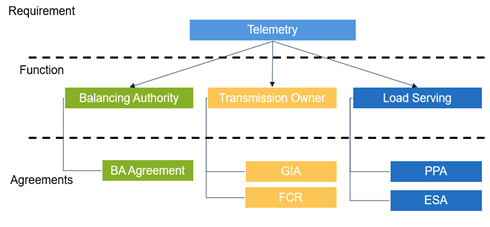
Figure 2: Example diagram of documents that contain telemetry requirements for SRP.
Building Better IBR Requirements
Once the need for better IBR technical requirements was identified, multiple Implementation Projects were executed to develop these improved requirements. These efforts occurred as part of Salt River Project’s 3-year Operational Readiness Implementation Program which involved key stakeholders across different utility departments to develop solutions for specific IBR challenges.
SGP led and supported these projects in close partnership with Salt River Project as a trusted advisor and IBR expert.
Several key IBR technical requirements projects are described below.
PPA Requirements
The majority of Salt River Project’s IBR generation and storage assets are contracted with project owners via a PPA or Energy Storage Agreement (ESA) contract. Salt River Project is the offtaker of the energy and capacity of these resources and has specified control and dispatch rights as governed by the contract terms. Previous versions of the PPA limited grid operators who are responsible for maintaining reliability in their Balancing Area by not containing detailed, IBR-specific technical and commercial provisions to fully unlock IBR plant capabilities.
Must-take solar PPAs without provisions for occasional curtailment by grid operators limited the grid’s capability to host additional solar. Energy Storage Agreements for battery projects included pre-set charge/discharge schedules that precluded grid operators from flexibly utilizing the batteries in response to dynamic grid needs.
Flexible IBR dispatch was an unrealized imperative for Salt River Project to fully unlock IBR project capabilities to support the grid and increase the grid’s capability to host more IBRs.
SGP revised the template PPA to implement the following improvements in dispatchability and unlock value streams:
- Developed commercial terms and technical provisions to enable occasional curtailment by grid operators to better balance the power supply and load with increased IBR generation
- Incorporated a battery storage dispatch framework that enabled flexible dispatchability within prescribed constraints without the confines of a static schedule
- Implemented more rigorous performance testing during commissioning
- Required automatic voltage control and frequency response for IBRs to perform ancillary services
- Updated plant availability and capacity determinations procedures to fairly assess a plant’s compliance with contractual commitments
These revisions allow Salt River Project to reliably serve customers with a more sustainable resource mix by having more flexible dispatch options and proven performance at commissioning.
Interconnection Requirements
Salt River Project’s responsibilities as a Transmission Owner/Operator and Balancing Authority necessitate consistent behavior and performance from resources connected to the transmission system. Similarly to the PPA template, the interconnection requirements in place were designed for traditional generation and needed to be updated for the technology differences present in IBRs.
SGP reviewed the existing interconnection requirements and engaged subject matter experts at Salt River Project to identify what technical requirements and plant performance specifications needed to be updated to provide specificity for IBRs and avoid past pain points. This need was highlighted by past IBR plants causing oscillations due to plant control issues and having different equipment installed than were represented in the plant models. These cause concerns for operators and transmission planners and can be addressed through stricter interconnection commissioning requirements and modeling requirements.
SGP also surveyed relevant industry performance standards and recommended integrating these into the updated interconnection requirements. SGP recommended a new format for the interconnection requirements that had a dedicated section for IBR requirements that would be easier for customers to reference and comply with. These improved standards were published in SRP’s latest Facility Connection Requirements (FCR) document, to which all transmission-connected customers must adhere.
Among other changes, SGP implemented the following requirements in the new FCR to enhance confidence in the reliability of future IBRs:
- Updated disturbance response ride-through requirements to be aligned with IEEE 2800
- Expanded range requirements for voltage control and frequency response to be aligned with IEEE 2800
- Hardware-in-the-loop test requirements for plant controllers
- More explicit and rigorous interconnection commissioning test requirements
Impact of Updated Requirements
The updates to the PPA templates and FCR that SGP implemented as part of the Operational Readiness program have allowed Salt River Project to continue integrating IBRs at a rapid pace and become a leading utility in operating large solar and BESS resources for multiple value streams, unlocking the full potential of IBRs. Today, Salt River Project grid operators regularly incorporate flexible IBRs in day-ahead planning and real-time operations, including depending upon IBR plants to provide critical grid ancillary services such as regulation.
These projects required bringing together a cross-functional team of subject matter experts, assessing Salt River Project’s various utility functions, and determining what new requirements were needed to get the full value out of solar and BESS resources. The continued success of the Operational Readiness program highlights SGP’s unique expertise in both the technology and value of IBRs as well as in understanding a client’s responsibilities and supporting them in achieving more with solar and storage.


